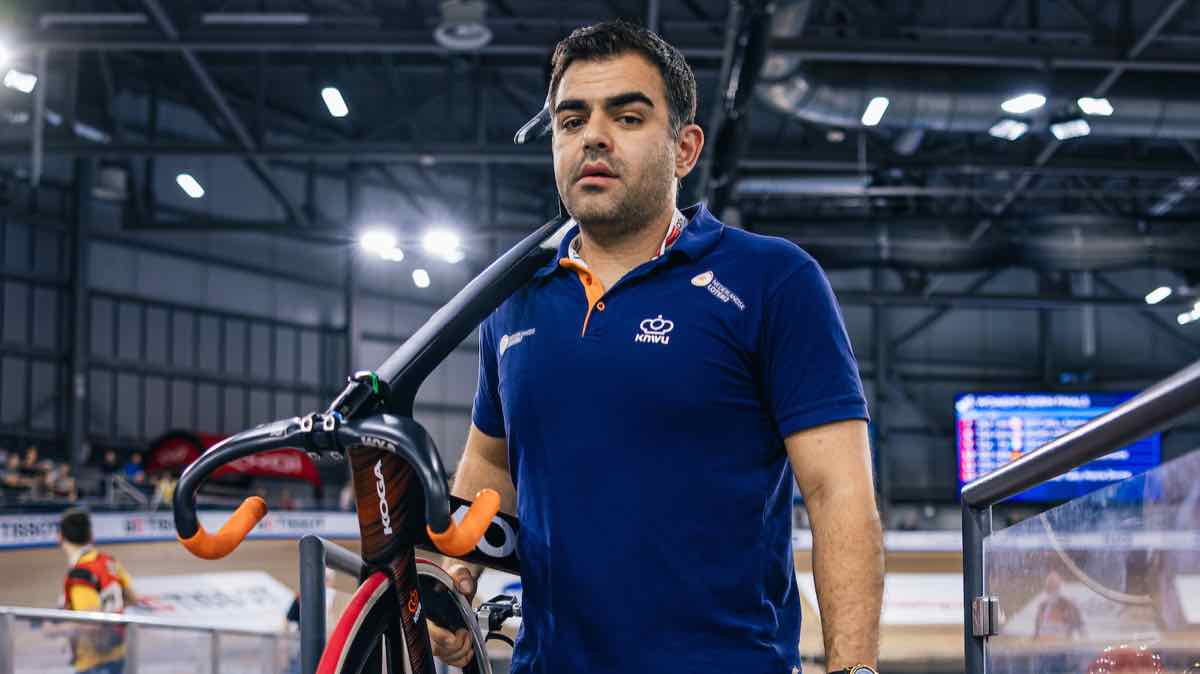
Mehdi Kordi, formerly the head coach of the Dutch track sprint team, has warned that cycling must prepare to defend track cycling’s status as an Olympic sport.
In a guest post for subscribers to journalist Daniel Benson’s Substack, Kordi highlights the International Olympic Committee’s recently revised criteria for determining its programme, based on individual ‘disciplines’ rather than broader definitions of a given sport.
There can be no arguing that track cycling does not fit the IOC’s definition of a distinct discipline: ‘one or more events within a sport that require either a dedicated field of play … generally involving a separate group of athletes’.
Each discipline will be ‘evaluated against core criteria, focusing on global appeal, cost and operational complexity, and athlete representation. A final stage will bring together high-performing candidate disciplines and lower-performing incumbent disciplines for direct comparison using consistent and objective measures.’ The threat is very thinly veiled there.
Kordi suggests that track cycling is safe for Brisbane 2032, with a velodrome already built, and a host keen to have it. But the position is less certain at future Games.
Among the cities showing interest in hosting 2036 are Ahmedabad, Budapest, Doha, Durban, Istanbul, Munich and Jeonju – none of which currently have suitable indoor 250m velodromes. Ahmedabad will host the Commonwealth Games in 2030, but its programme of 15-17 sports is not yet finalised – and cycling, never mind track cycling, is not guaranteed a place.
Kordi points to the collapse of the UCI’s Track Champions League as evidence that track cycling is already failing the global appeal test, claiming that Warner Bros. Discovery terminated the competition because ‘hardly anyone was watching’. Viewers did not know who the riders were, or why they should care.
He notes that track sprinters were the biggest losers in the Track Champions League’s disappearance: ‘it was the only thing that paid them to race in Europe, other than the government funding they receive.’ But of course, that’s only true for the lucky few who do receive such funding.
Kordi calls for a dedicated racing calendar, plus a qualification system based on individual rider participation rather than national teams. And he also accepts, track cycling must take an honest look at itself: he shares the story of a rider who said they would rather finish 50th in the Amstel Gold road race, than fight for a medal at a track world championship.
His comments should sound alarm bells at the UCI, who were, notably, never directly name-checked in Kordi’s piece. They may now be required to demonstrate genuine commitment to track cycling as a global, sustainable and representative sport.
Defending the status quo – as they did when challenged by the DerbyWheel project to expand the viable Japanese and Korean business models of keirin racing, promising a career path for sprinters in Europe and elsewhere – may not be enough.